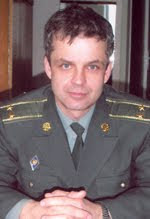
Det känns verkligt roligt att få dela med mig av allt som händer i Poltava till SMB:s medlemmar, säger överstelöjtnant Oleg Bezverknii glatt. Det är den 26 juli 2009 och Oleg är på besök i Sverige, bl.a. för arkivstudier vid Krigsarkivet. Oleg har sedan mer än tio år tillbaka varit SMB:s kontaktperson i Poltava och många av oss som rest till Poltava har träffat honom. Han har tidigare varit lärare vid Militärhögskolan i Poltava, men är sedan ett par år pensionerad och arbetar vid Lantbrukshögskolan i samma stad.
Ett resultat av Olegs Sverigebesök i juli 2009 är att Oleg startar en Poltavablogg på SMB:s webbsajt. Här meddelas såväl reflektioner över stora nordiska kriget och slaget vid Poltava som nyheter om vad som händer i den ukrainska provinshuvudstaden Poltava.
jag hoppas att bloggen kommer att bli ett litet inslag i arbetet med att stärka banden mellan Sverige och Ukraina, men framför allt vill jag öppna ett fönster till en del av Europa som få svenskar känner till, säger Oleg.
Bloggen skrivs på engelska, som är det främmande språk vid sidan av ryskan) som Oleg behärskar.
The delegation of the Swedish Association of the military history (SMB) visited Poltava on September 13-17. During three-day-long stay in Poltava the delegates visited many sights of the Poltava Battle field, had a meeting with the staff of the Poltava Battle Museum, visited a place where the King Charles XII was wounded on the eve of the Battle of Poltava and planted two oak-trees together with local inhabitants near the monument to fallen Swedish warriors erected by their compatriots near the village Pobyvanka.
The SMB delegation near the redoubt reconstructed in 1909 on the eve of the celebration of 200th anniversary of the Battle of Poltava
The SMB delegation near the redoubt reconstructed in 2009 on the eve of the celebration of 300th anniversary of the Battle of Poltava
Poltava military reconstructor Mikhail Mellin (far left) shooting a gun salute to the Swedish guests
Swedes and Ukrainians near the Monument to the fallen soldiers of the King Charles XII
The oak-tree planted by Swedes and Ukrainians near the Monument
August 21, 2017 (Military.com) Defense
Secretary Jim Mattis is set to travel to Ukraine, becoming the first U.S.
defense secretary to visit the country since Robert Gates, the Pentagon
announced Friday. Mattis will meet with Ukrainian President Petro Poroshenko
and Defense Minister Stepan Poltorak on Aug. 24, Ukraine's independence
day. "During these engagements, the secretary will reassure our Ukrainian
partners that the U.S. remains firmly committed to the goal of restoring
Ukraine's sovereignty and territorial integrity, as well as strengthening the
strategic defense partnership between our two countries," the Defense
Department said.
Mattis' trip comes as the United
States is mulling giving Ukraine lethal weapons after Russia's annexation of
Crimea in 2014 and its ongoing incursion into Ukraine's eastern border regions.
The U.S. has given Ukraine's military non-lethal supplies, including
night-vision goggles, uniforms and surveillance equipment such as Raven RQ-11BAnalog
mini-drones. But U.S. officials worry -- with seemingly endless breakouts of
hostilities between pro-Russian separatists and Ukraine's national guard --
that the conflict will prolong without expanded support. Senate Armed Services
Committee Chairman Sen. John McCain, an avid supporter of arming Ukraine since
then-President Barack Obama cautioned against lethal weapons, has raised the
issue repeatedly with defense officials.
During Deputy Defense Secretary
Patrick Shanahan's confirmation hearing in June, McCain was unhappy with the
incoming deputy's answers about providing arms to Ukraine. "It's still
disturbing to me after all these years that you would say that you have to look
at the issue," the senator said. "Have you not been aware of the
issue? Have you not been aware of the actions of the Senate Armed Services
Committee? Have you not been aware of the thousands of people that have been
killed by Vladimir Putin? Have you missed all that in your duties at one of the
major defense corporations in this country?" Mattis will also travel to
Turkey and Jordan next week, meeting with his counterparts to discuss the ongoing
air war against the Islamic State in Iraq and Syria.
August 18, 2017 (BBC Europe) The Security
Service of Ukraine (SBU) warned of a possible new cyber attack on Ukrainian
institutions and companies. The SBU believes that the "Petya"
virus, which attacked the Ukrainian information systems on June 27 this year,
could be a "preparatory phase for a second wave of cyberattacks". After
investigating the events of June 27, the SBU has discovered that the virus
collected data from electronic mailboxes, passwords for accounts, server access
details, and hash data user accounts. Specialists of the SBU assume that getting
this information was the main objective of the first wave of cyberattacks and obtained
data could be used by the real initiators for both cyber intelligence and for
further destructive actions.
August 9, 2017 Mr Martin Hagström, Ambassador of Sweden to
Ukraine visited Poltava Battle Museum and laid a blue-yellow bunch of flowers
to the Monument to the fallen Swedish warriors erected in 1909 by their
compatriots near the village Pobyvanka. I was very pleased to tell a story of
the monument to Mr Hagström and answer his questions. Besides we were
discussing a question regarding commemoration of fallen warriors of the King
Charkes XII. Many thousand of them were buried in a hurry near the village Tachtaulove. Despite more than 300 years have passed since the Battle of
Poltava the main burial place of caroliners is still not marked even with a very
modest memorial stone.
During the visit to Poltava Battle Museum Mr Hagström was guided by Viktor Myroshnyk, the senior researcher at the museum
who speaks pretty good Swedish. Mr Hagström supported an idea of sending
Viktor Myroshnyk to Sweden for the summer courses in Swedish language in the
near future.
Besides the battle field Mr Hagström visited a
memorial stone unveiled recently in the village Nyzhni Mlyny on the place where
King Charles XII was wounded on the eve of the Battle of Poltava.
Near the entrance to the Museum of the Battle of Poltava
Mr Hagström and Viktor Myroshnyk in the museum
Mr Hagström is laying frowers to the Monument to the Swedish warriors killed in the Battle of Poltava
Mr Hagström and Oleg Bezverkhnii near the monument
June 18, 2017
(CNN) In the sometimes hostile waters of the Persian Gulf looms the US Navy's
first -- in fact, the world's first -- active laser weapon. The LaWS, an
acronym for Laser Weapons System, is not science fiction. It is not
experimental. It is deployed on board the USS Ponce amphibious transport ship,
ready to be fired at targets today and every day by Capt. Christopher Wells and
his crew. CNN was granted exclusive access to a live-fire test of the laser. "It
is more precise than a bullet," Wells told CNN. "It's not a niche
weapon system like some other weapons that we have throughout the military
where it's only good against air contacts, or it's only good against surface
targets, or it's only good against, you know, ground-based targets -- in this
case this is a very versatile weapon, it can be used against a variety of
targets."
LaWS begins
with an advantage no other weapon ever invented comes even close to matching. It
moves, by definition, at the speed of light. For comparison, that is 50,000
times the speed of an incoming ICBM.
"It is
throwing massive amounts of photons at an incoming object," said Lt. Cale
Hughes, laser weapons system officer. "We don't worry about wind, we don't
worry about range, we don't worry about anything else. We're able to engage the targets at the speed
of light."
For the test, the USS Ponce crew
launched the target -- a drone aircraft, a weapon in increasing use by Iran,
North Korea, China, Russia and other adversaries. Immediately, the
weapons team zeroed in. "We don't have to lead a target," Hughes
explained. "We're doing
that engagement at the speed of light so it really is a point and shoot -- we
see it, we focus on it, and we can negate that target." In an instant, the
drone's wing lit up, heated to a temperature of thousands of degrees, lethally
damaging the aircraft and sending it hurtling down to the sea. The
strike comes silently and invisibly. "It operates in an invisible part of
the electromagnetic spectrum so you don't see the beam, it doesn't make any
sound, it's completely silent and it's incredibly effective at what it
does," said Hughes.
It is remarkably precise, which the
Navy says could limit collateral damage in wartime. "I can aim that at any
particular spot on a target, and disable and destroy as necessary," said
Wells. "It reduces collateral damage -- I no longer have to worry about
rounds that may go beyond the target and potentially hurt or damage things that
I don't want to hurt or damage." All the $40 million system needs to
operate is a supply of electricity, which is derived from its own small
generator, and has a crew of three. No multi-million-dollar missile, no
ammunition at all. The cost per use? "It's about a dollar a
shot," said Hughes.
Today, the
laser is intended primarily to disable or destroy aircraft and small boats. "It's
designed with the intent of being able to counter airborne and surface-based
threats," said Hughes. "And
it's been able to prove itself over the last three years as being incredibly
effective at that." However, the Navy is developing more powerful,
second-generation systems which would bring more significant targets into its
crosshairs: missiles. Those missions remain classified. However, the
commander and crew are very much aware of the potential capabilities. When we
asked Wells if the current LaWS could shoot down a missile, he said simply
"maybe" and smiled.
The idea of going to Halden and Fredriksten has never left me since I started to make a careful study of the Great Northern war and the Battle of Poltava. This year with the help of my Swedish and Norwegian friends this dream has come true. I got two unique Norwegian guides: Magne Rannestad and Stig Østling. These two men ave turned my trip into something unforgettable.The fortress of Fredriksten was constructed in the 17th century when the fortress at was ceded to Sweden in accordance with the Treaty of Roskilde (1658). The fortress was named after King Fredrik III of Denmark and Norway. There were six attempts taken by Sweden from 1658 till 1814 to take the fortress but the fortress withstanded bravely all sieges. On the evening of 30 November 1718, a bullet killed Karl XII while he inspected the siedge work near the fortress. Nowaday the fortress of Fredriksten is well cared for and attracts tourists from many countries. Magne Rannestad as a head of the Society of the friends of the foretress works hard to maintain this historical monument in a good shape. I was impressed with a very interesting museum of the fortress of Fredriksten showing its history since 17th century till the present day. The tourism infrastructure created since the fortress has stopped to be a military object came as a surprise to me.
Oleg Bezverkhnii and Magne Rannestad near the monument on the place where Karl XII was killed in 1718.
Stig Østling organized for me a guided tour around downtown of Halden that was known as Fredrikshald between 1665 and 1928 and gave me an opportunity to see monuments dedicated to Norwegian campaign of the King Karl XII of 1716 and 1718. Some of these monuments were very difficult to be found in the wild depth of Sweden and Norway.
Stig Østling near the monument erected in 1922 at the end of Galärvägen, where Swedish army moved twelve galleys over land from Skagerrak at Strömstad to Idefjorden. The aim of this operation was to reinforce the Swedish army prior to an attack to the fortress of Fredriksten in 1718.
Stig Østling has been to Poltava a few times and he can speak Russian a bit. In 2016 he visited a place where the King Karl XII crossed Dniper River in 1709 after the Battle of Poltava.
Stig Østling with the flag of Halden inside the reconstructed redoubt on the Poltava Battle field.
From time to time the fortress of Fredriksten hosts the summer theater where the audience can enjoy classic and rock music.
July 7, 2017 (UNIAN) The U.S. and Russia have reached agreement on a ceasefire in southwest Syria, AP sources said as U.S. President Donald Trump held his first meeting with Russian President Vladimir Putin, while CNN reported that the two leaders also discussed Ukraine, cybersecurity and terrorism.
The Syria ceasefire deal marks a new level of involvement for the U.S. in trying to resolve the Syrian crisis. Although details of the agreement were not immediately available, the cease-fire is set to take effect Sunday at noon Damascus time, said the officials, who weren't authorized to discuss the ceasefire publicly and spoke on condition of anonymity, Associated Press reports.
At the same time, CNN with the
reference to Russia's state-owned news organization Sputnik quoted Vladimir
Putin as saying that he "had a very lengthy conversation with the
President of the United States, there were a lot of issues such as Ukraine,
Syria, other problems, some bilateral issues."